

Process mapping
Document triggers, participants, conditions, inputs and expected outcomes for each step.
Business process automation for enquiries, approvals, documents and data exchange between your CRM, website and other systems.
Business Process Automation & System Integration
Workflow automation starts with a repeatable process whose rules can be described and tested. We connect enquiries, CRM records, approvals, documents and notifications through APIs and webhooks. Each workflow includes agreed error handling, human approval points and an owner so routine task automation remains manageable.
Move agreed data between systems on events or schedules.
Status and activity records show progress and the next owner.
Failures trigger notifications, retries or a clear manual route.
Solution concepts
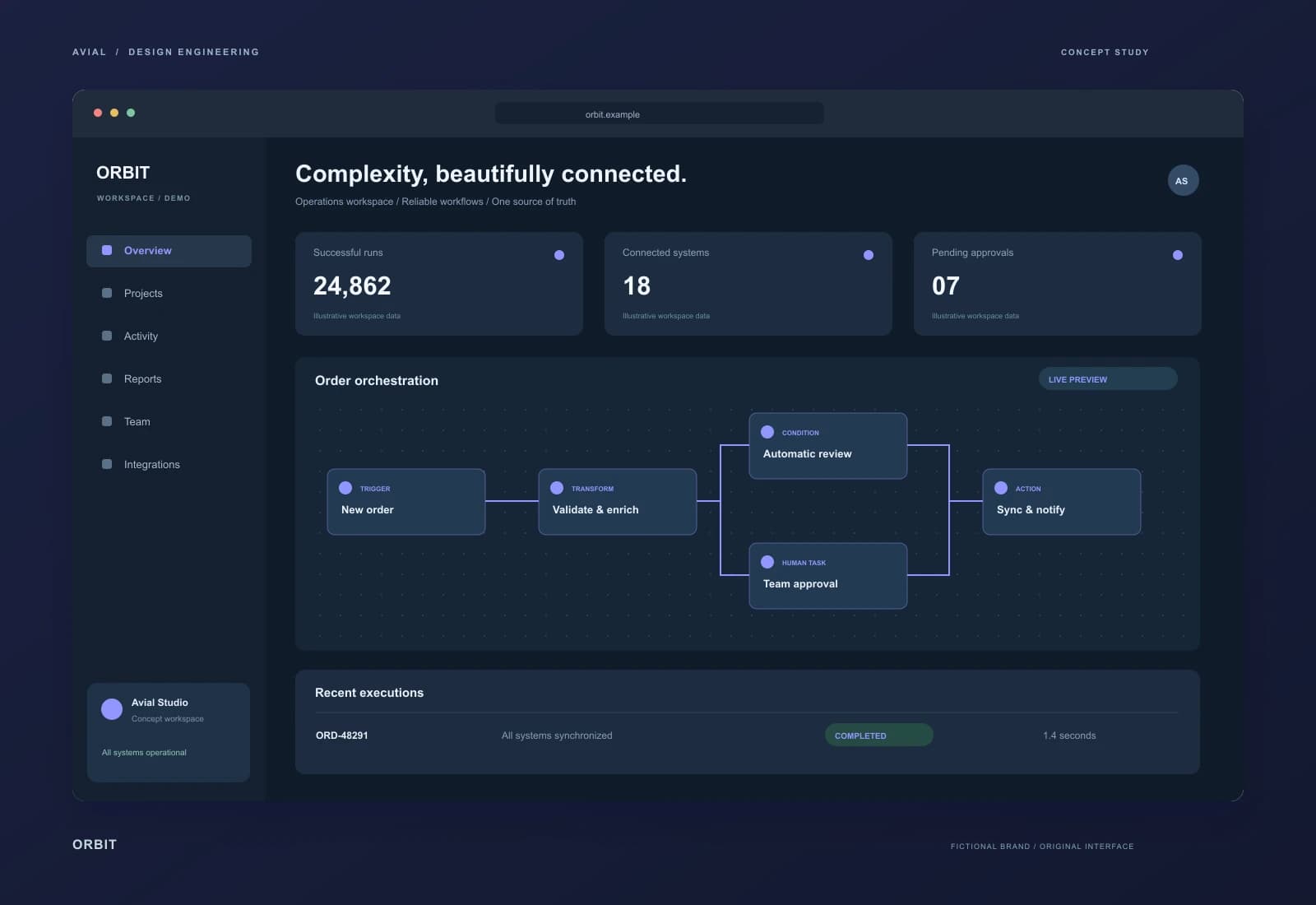
The control room for connected operations
An automation platform concept where every process has a visible flow, an execution history and an owner. Teams can locate a failure, retry the relevant step and verify the result.
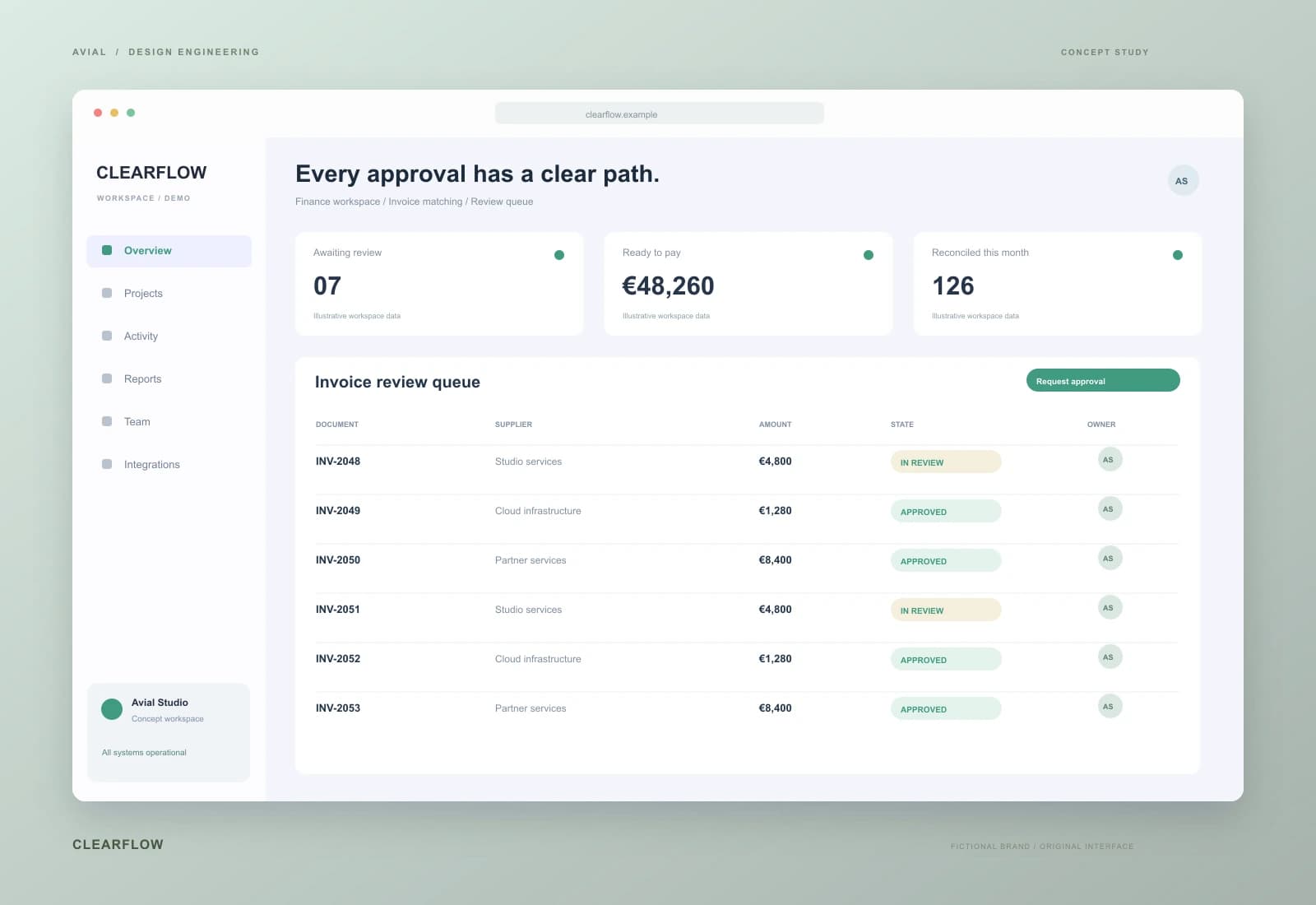
A clear path through every approval
A finance operations concept connecting invoice validation, approval and accounting synchronization. Exceptions have a clear review queue, and every decision remains traceable.
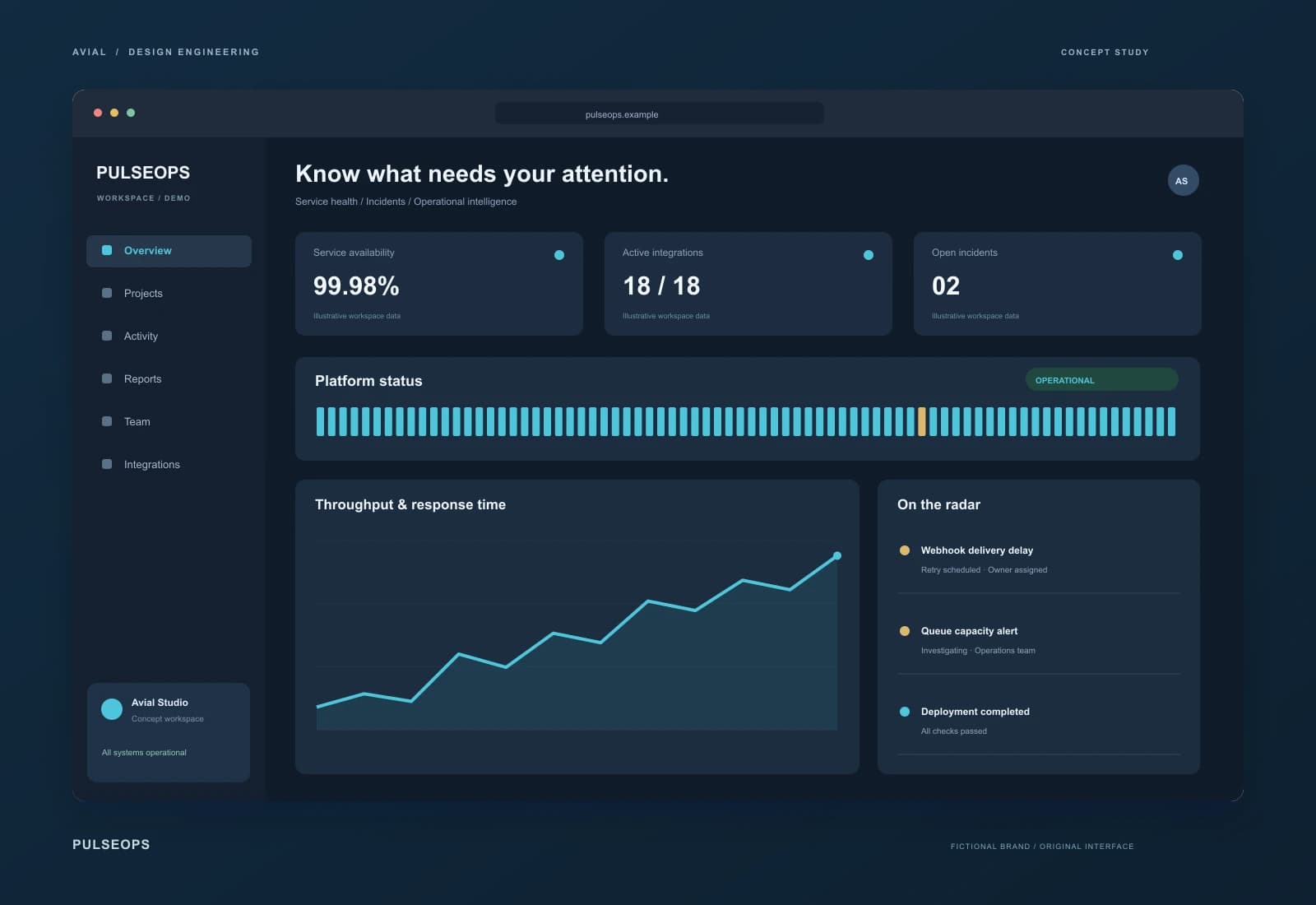
A live picture of the whole operation
An operations dashboard concept for a service platform. Integration health, task queues and incidents share one workspace, connecting each signal to its cause and the next useful action.
Original concepts for fictional brands, illustrating our approach to design and implementation.
What you get
Document triggers, participants, conditions, inputs and expected outcomes for each step.
Use available APIs, webhooks and agreed exchange formats, choosing tools around the workflow.
Plan retries, duplicate protection, permissions and behavior when external services are unavailable.
Add activity records, alerts and instructions, then explain how to review and change the workflow.
Each step has a reason, an input and an expected outcome. A documented, observable workflow is easier to maintain, hand over and extend as the business evolves.
When staff copy data between a website, CRM and back-office system, define the event, required fields and ownership. Begin where rules are clear and each run has a verifiable outcome.
Map roles, conditions and deadlines: who checks, who decides and what happens on rejection. Signing, payments and other consequential actions need explicitly approved authority.
Remove recurring manual collection of the same information. Record each metric's source, period and update time so an automated report remains understandable and auditable.
Receive current and proposed process maps, events, fields and exceptions. Compare ready-made connectors, workflow platforms and custom development by constraints, maintainability and total cost.
Define retries, duplicate protection, event ordering and manual intervention. Verify request origin and permissions. Irreversible actions need a separate confirmation from the authorised person.
Run a limited volume, reconcile outcomes against the manual process and supply instructions. Staff can inspect successful and failed runs, causes and next actions. Agree how to pause and resume the workflow.
An illustrative specification, not a savings promise or client result. Measure actual volume, errors and staff time before and after the pilot.
| Event | Workflow behaviour | Acceptance criterion |
|---|---|---|
| The event arrives twice | Recognise the same identifier | One order without a duplicate invoice |
| An external system is unavailable | Limited retries and an alert | A visible task, manual fallback and accountable owner |
| Required information is missing | Pause the affected step for clarification | An incomplete document is not sent automatically |
Scope depends on systems, branches, data formats, exceptions and peak run frequency. List paid connectors, operation limits, hosting and support separately. A cheaper prototype can have higher running costs, so compare both parts.
Describe one complete process, how often it runs and where staff intervene. Estimate payback from your data: time saved and reduced rework minus system and oversight costs. No savings percentage is invented without a baseline.
Before the pilot, record cycle time, manual minutes, error rate and exception volume. Compare equivalent tasks after rollout, including review and correction time. A successful API response alone does not prove a business process completed correctly.
A data map defines the authoritative system for each field and conflict rules. Run reference events before changes and inspect logs after release. If the process changes frequently or rules are unclear, clarify it with its owner before automating it.
From brief to launch
Review frequency, manual work and the cost of mistakes.
Map the main path and exception handling.
Exercise successful, repeated and failed events.
Launch with monitoring and hand control to the team.
Before we start
Choose a repeatable, well-understood workflow with measurable manual effort and a verifiable outcome, such as enquiry transfer or document approval.
We define that behavior in advance: queues, bounded retries, alerts and a manual route, based on urgency and system capabilities.
Yes. We document the workflow and separate configuration from logic. Significant changes are validated with test events first.
Choose by connector availability, logic, volume and handover needs. No-code still requires testing and maintenance; custom code is not automatically justified for a simple workflow.
Review supported imports, exports or another agreed interface. UI automation can be fragile, so its constraints and maintenance need a separate assessment.
Store event identifiers and check operation state before retrying. Establish the external system's idempotency and reconciliation capabilities.
Yes. Define automatic steps and those that wait for confirmation. Rejection, expiry and reassignment also need clear paths.
Yes. Assign ownership for APIs, workflow logic, environments and support. Supply specifications, reference events and verification results.
Contract changes require connector review and testing. Monitoring, updates and response times belong in an agreed support scope rather than being assumed.
Process maps, field rules, configuration or agreed source code, test scenarios and pause/recovery instructions. Third-party platforms retain their own licence conditions.
AVIAL SERVICE
Describe a repeated task and the systems between which your team moves information.
Describe your goal and current setup. We will clarify scope, costs and a first phase. An enquiry does not commit you to a purchase.
Estimate IT service costs, book a consultation and try an enquiry automation example. Use the website check to start a discussion about technical SEO and page speed.