

AI search and website audit
Review answers to priority questions, cited sources and the competitive context. Check indexing, page accessibility and search crawler access rules.
Generative Engine Optimization for ChatGPT, Gemini and Google AI: AI visibility audits, useful content and brand mention monitoring.
GEO for websites and brands in AI search
Generative Engine Optimization (GEO) prepares your website and brand information for AI search. We combine SEO foundations, expert content and source monitoring for questions in ChatGPT, Google AI Overviews, Gemini and Perplexity. AI search optimization focuses on clear, verifiable information and on reviewing how answers describe and cite your business.
Your website explains what you do, who you help and which facts support your expertise.
We focus on how customers actually choose: use cases, terms, comparisons and practical limitations.
We record answers and sources for agreed queries and track the referrals and enquiries available in your analytics.
Solution concepts
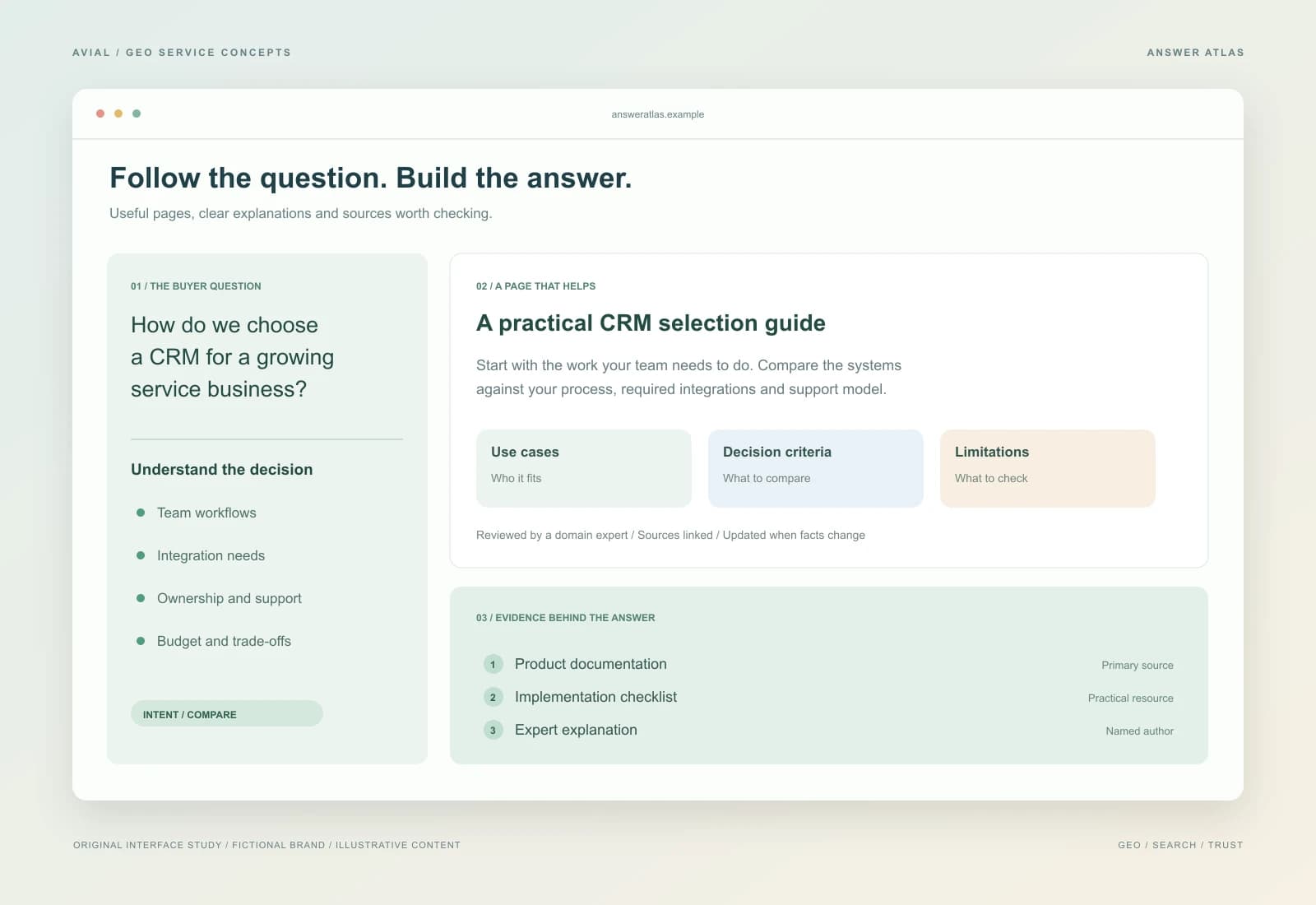
A useful answer starts with a useful page
A content map concept for a B2B company: from buyer questions to pages with clear explanations, selection criteria and verified sources. This illustrates the approach, not the results of a client engagement.
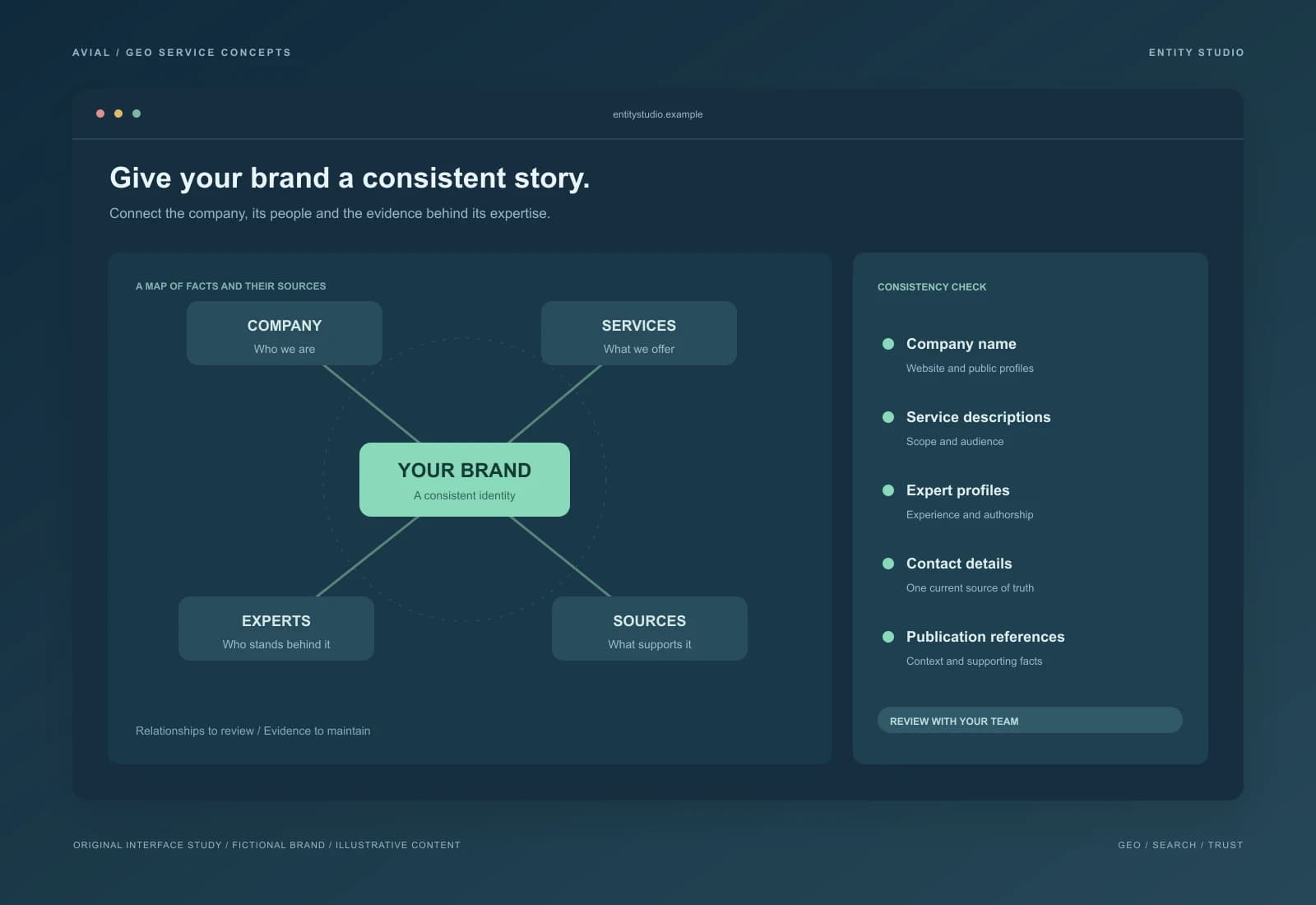
One brand. Consistent facts.
A brand map concept connecting the company, experts, services and publications. It helps identify conflicting descriptions and determine which claims need supporting evidence.
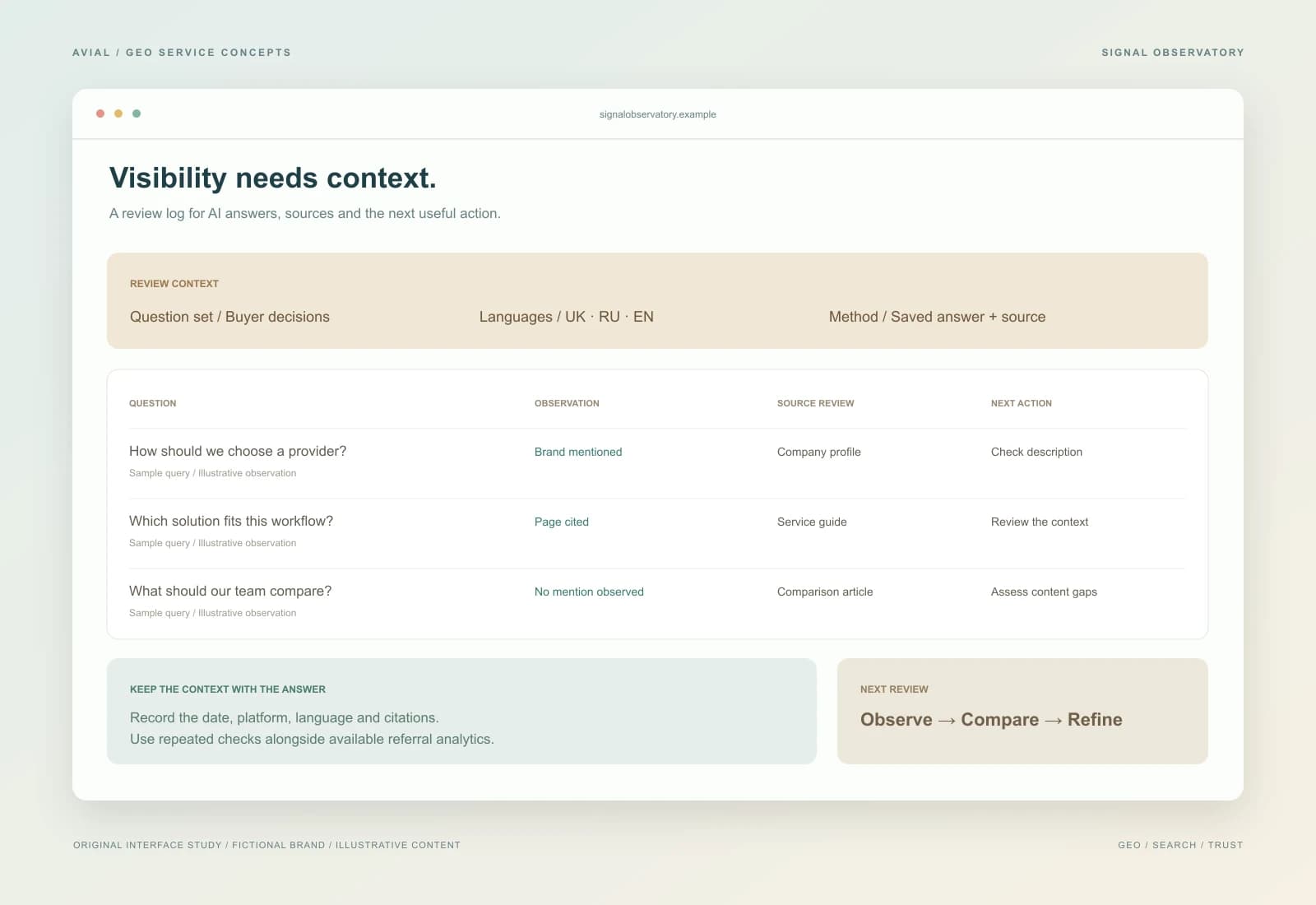
Observations with context
An AI visibility review log concept: record the question, language, platform, answer and source. This approach supports discussion of specific changes and makes the next review easier to plan.
Original concepts for fictional brands, illustrating our approach to design and implementation.
What you get
Review answers to priority questions, cited sources and the competitive context. Check indexing, page accessibility and search crawler access rules.
Plan service pages, useful FAQs, comparisons and explanations. Work with your specialists, check facts and add authorship and references to original sources.
Align the company name, description, products, contact details and profiles. Review appropriate structured data and opportunities for expert contributions to relevant publications.
Keep a review log with dates, languages, platforms and sources. Compare observations with available analytics and identify the next priorities.
ChatGPT SEO starts with pages that help a buyer understand your service: its scope, intended audience, pricing factors and evidence of experience. Generative Engine Optimization prepares this content and your brand information for search in ChatGPT, Gemini, Google AI Overviews and Perplexity.
AI SEO combines technical website accessibility with clear answers to customer questions. Website optimization for AI search includes content structure, verified facts and useful source references. To support brand visibility in ChatGPT, we also review company names, specialisms and external profiles for conflicting information.
GEO and LLM optimization build on conventional SEO. Our deliverables include an agreed improvement plan, updated content and a method for checking AI visibility. Reports distinguish brand mentions, page citations and website referrals; each platform decides which sources to use.
A buying journey can start with a detailed question: which system to choose, how services differ or who can handle implementation. GEO helps you prepare content that answers those questions and accurately explains your offer. It is especially relevant to B2B companies, professional services, online stores and brands with considered purchasing decisions.
You receive an audience question map, a review of your pages and brand mentions, a prioritised action plan and an agreed set of content. We define implementation scope, languages, markets and reporting frequency before work begins. Your team retains the content and account access.
An initial audit is a standalone deliverable your team can act on, or use to continue implementation with Avial. Before starting, we agree on platforms, languages, markets, page and question counts, deliverables and acceptance criteria.
For teams that need a baseline and a prioritised plan for AI Search Optimization.
You receive an agreed question map, a baseline review log with responses and sources, and a list of technical and content issues. Every action identifies a URL, supporting evidence, a priority and a way to verify the fix.
For teams ready to approve and deliver an existing action plan.
You receive an agreed set of updated pages, verified brand information and technical fixes. The handover includes a change log of URLs, editorial assets and validation results. Development and external publications are included only when agreed in scope.
For teams that need to review changes after implementation and decide what to do next.
You receive repeated reviews of an agreed question set, separate mention and citation measures, and available referral and enquiry data. Every report explains sample limitations, lists completed work and sets out the next priorities.
Review the template before contacting us: it shows the deliverable and verification method. This is a blank working document, not a client case study or evidence of growth.
Pricing follows scope: platforms, markets and languages, questions and repeated checks, website condition, content volume and implementation complexity. A proposal separates the audit, content, technical work and any tool or publication costs. Each subsequent phase requires its own agreement.
For an estimate, share your website, brand name, priority services and target markets. Delivery may require analytics access, factual materials and a subject expert to review content. We arrange access after agreeing scope.
We agree on a delivery schedule and review deadlines before each phase begins. Task completion dates are distinct from the time external platforms take to recrawl pages or change answers. If search access is blocked or supporting material is missing, the first priority is to address those prerequisites.
The aim is to improve the likelihood that relevant AI answers accurately represent your business or use its material as a source. We agree on measurable objectives rather than promising a recommendation or a fixed position.
Track the share of reviewed scenarios that mention the business, separately by platform, language and market.
Check whether a mention matches your service, audience and delivery area. A name match alone is not a recommendation.
Record source URLs and citation context: which part of the customer’s question does the page help answer?
Reduce conflicting descriptions of the company, products and experts, with verifiable support for material claims.
Review available AI referral traffic and conversions. Report mentions without a visit separately, acknowledging attribution gaps.
ChatGPT optimization starts with the decisions your customers need to make: comparing providers, understanding limitations or finding a specialist for a specific problem. We test branded and unbranded questions separately. That distinction helps establish whether an answer merely recognises a company name or discovers its material during a search. For ChatGPT Search, we check that OAI-SearchBot can access relevant pages; search access and permission to use content for model training are separate considerations.
Our work then focuses on clear service pages, purchasing criteria, expert explanations and evidence behind claims. ChatGPT SEO does not give a supplier control over recommendations. We record the question, search mode, date, brand mention and cited URL. Where a visit follows, we connect available referral data with enquiries or other meaningful actions rather than treating every mention as a lead.
AI Search Optimization for Google builds on organic search visibility. Google does not require special GEO markup: a supporting page needs to be indexed and eligible for a search snippet. We therefore start with accessible URLs, substantial content and useful internal links. Instead of promising to place a website in an AI Overview, we ask which page best answers the buyer’s question and what information is missing from it.
We develop service comparisons, process explanations, selection criteria and answers to objections. Each page has a distinct purpose to avoid producing multiple near-identical landing pages. Observations of AI results go into a separate review log, while organic search data provides additional context. We do not label all Google visits as AI traffic or assume that an AI Overview will appear for every question.
Gemini is a separate product, so a result observed in Google AI Overviews is not automatically a Gemini result. Gemini responses may include sources or related links, but not every response does. Our reviews distinguish a brand mention, a link to the business and a page offered to help verify a statement. Keeping those observations separate avoids inflating AI visibility with unrelated links or matching company names.
For international campaigns, we create market-specific questions rather than relying on literal translations. We review the company name, service area, contact information and supported claims across the website and public profiles. Content should explain actual delivery conditions and limitations in each market. We assess Gemini visibility through repeated observations, saved answers and the accuracy of the company description, not through a single favourable screenshot.
For Perplexity, we focus on material that helps a reader investigate a subject: solution comparisons, practical methods, technical explanations and answers to specific questions. We check access for PerplexityBot, including restrictions imposed by hosting security. Accessibility is a prerequisite for discovery, not a promise that the platform will select a page. Every priority article should have a clear purpose, independent value and a demonstrable connection to the team’s expertise.
In observed responses, we examine which statement a citation supports and whether the destination page is appropriate. An outdated description calls for a correction at its source. A missing comparison may justify a new article for a particular audience. This approach connects editorial work with reviewable outcomes and gives the business a concrete, prioritised set of next steps for its AI SEO programme.
Start with evidence you can publish: completed work, team expertise, methods, service conditions and verified feedback. Explain who a solution suits and when a different approach would be appropriate. These details help a person assess your offer and provide a substantive basis for accurate brand mentions.
Plan external coverage where there is a relevant audience and an editorial reason to discuss the business. Links and mentions should support specific expertise. The concepts on this page demonstrate a method; a client case study requires permission and verified before-and-after observations, including dates, questions, completed work and source URLs.
AI SEO, AI Search Optimization and LLM Optimization are often used for overlapping marketing work. GEO adds a focus on generative answers; it does not remove the need for useful content, technical accessibility or credibility. The comparison describes different areas of emphasis, not mutually exclusive tactics.
| Focus | SEO | GEO |
|---|---|---|
| Primary objective | Organic search visibility and qualified visits | Accurate brand mentions, citations and visits from AI answers |
| Questions | Keywords interpreted together with search intent | Questions, follow-ups and buying scenarios |
| Content | Pages that satisfy the searcher’s intent | The same strong pages plus clear answers, comparisons and verifiable facts |
| Credibility | Reputation, useful material and relevant links | Shared foundations plus reviews of mentions and consistent entity information |
| Measurement | Impressions, rankings, clicks and conversions | Mentions, cited URLs, answer accuracy, referrals and conversions |
| Platforms | Google and Bing organic search | ChatGPT Search, Google AI Overviews, Gemini and Perplexity |
From brief to launch
Discuss your products, languages and goals. Agree on platforms and a question set that matters to your business.
Collect sample answers and review your website and external sources. Build a plan with priorities, owners and a clear scope.
Update pages, develop material with your experts and address technical barriers. Each stage goes through an agreed review.
Repeat checks and assess available data and new customer questions. Reports distinguish delivered work from observed changes in visibility.
Before we start
Generative Engine Optimization (GEO) is work on how a website and brand can appear in AI answers. It complements SEO with checks of AI queries, accurate company descriptions and cited sources. Accessible pages and useful content remain the foundation. A special file or markup alone does not secure mentions.
No one can guarantee that a brand will be included or appear in a particular position. Answers depend on the platform, query, time and context. We agree on concrete deliverables and a review method; we do not sell guaranteed AI recommendations.
After the audit, we agree on a plan and budget based on website condition, page count, languages and content scope. Indexing and changes in AI answers depend on external systems. Reports cover mentions, sources and available referrals; some interactions do not produce a measurable website visit.
Start with public pages that clearly describe your services and answer buying questions. Review search access and factual information about the company, then test defined scenarios. A brand mention, a citation and a website visit are different outcomes. There is no application that guarantees an organic recommendation.
We can assess the business against market-specific buying questions and prepare relevant language versions. Pages should explain delivery locations, working languages and supported experience. A translated page is a starting point, not evidence that the company is visible in another market’s AI answers.
A complete source-selection formula is not public. Our practical review checks whether a page is accessible to search, relevant to the question and supported by verifiable information. We record the search mode and test context. An answer produced without web search is not a test of your website’s current search availability.
Relevant links and independent coverage can form part of a broader visibility and reputation programme. We plan them around something worth referencing, such as original research, a case study or an expert explanation. We do not treat purchased link volume as a GEO success metric or promise that a particular placement will produce an AI citation.
Consider llms.txt as an optional navigation aid when there is a practical reason to provide one. It does not replace accessible HTML, indexing, robots.txt or useful content. We explain the purpose of a proposed implementation rather than selling a file as a requirement or a guaranteed route into AI answers.
AEO commonly refers to optimization for direct answers, GEO to generative search, and LLM Optimization is often used for related marketing work. These labels do not have a single universal standard. Agree on the actual scope: platforms, markets, languages, pages, sources and review criteria.
Create a set of branded and unbranded questions. Repeat reviews while recording the date, language, market, platform, search mode, answer and source URLs. Separate mentions from citations and compare the same question sets. A single answer or screenshot cannot establish consistent visibility.
AVIAL SERVICE
Share your website, priority services and target markets. We will discuss an initial GEO audit and suggest a scope that fits your project.
Tell us about your brand and goals so we can clarify scope, pricing and next steps. Sending an enquiry does not commit you to a purchase.
Estimate IT service costs, book a consultation and try an enquiry automation example. Use the website check to start a discussion about technical SEO and page speed.