

Crawling and indexing
Review status codes, redirects, canonicals, robots, sitemaps and access to key pages.
Technical SEO audits and implementation covering indexing, website speed, Core Web Vitals, duplicate content and multilingual URLs.
Technical SEO & Core Web Vitals Optimization
Technical SEO removes barriers to search indexing and usable pages. We review crawling, rendering, duplicate URLs, canonicals and hreflang alongside website performance. Core Web Vitals optimization targets measured LCP, INP and CLS issues, followed by checks of affected templates and essential user journeys.
Connect issues with a template, user journey and technical source.
Focus first on changes affecting important pages and actions.
Compare like-for-like conditions and document remaining constraints.
Solution concepts
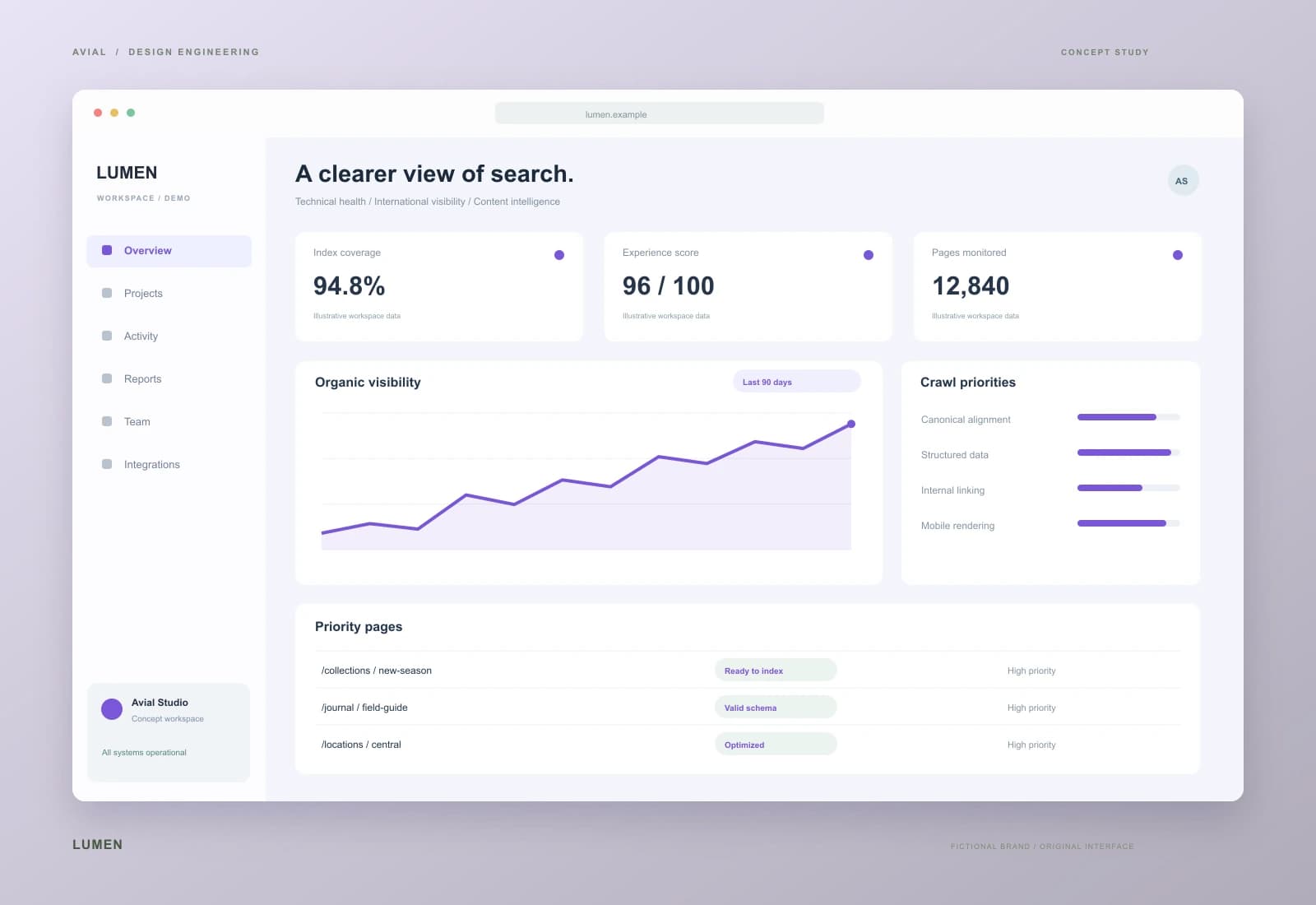
Search visibility without blind spots
A technical SEO workspace concept for a large multilingual site. Index coverage, prioritized issues and post-release checks share one clear view, so every recommendation has an owner and a verification step.
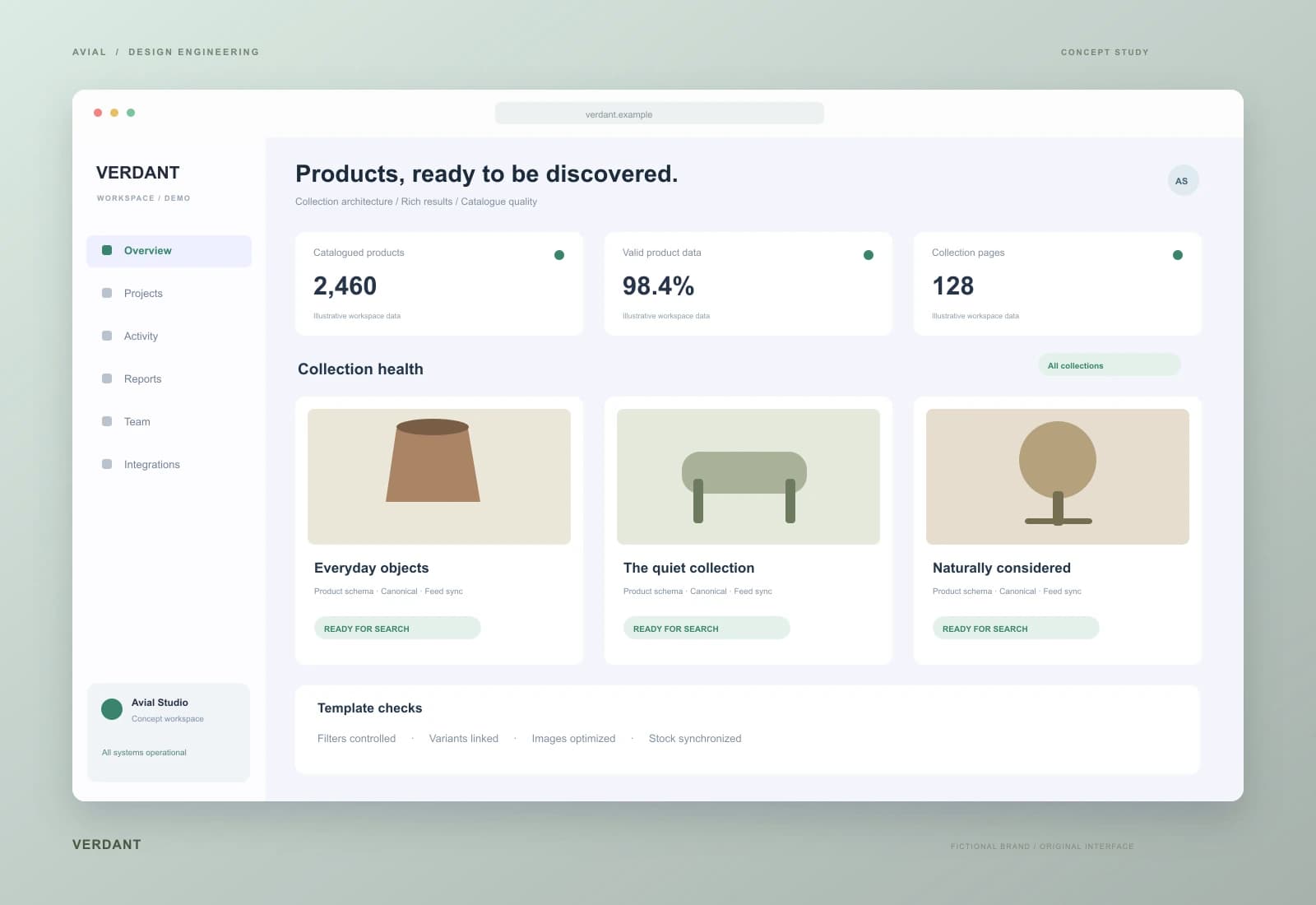
A product catalogue built to be found
An e-commerce SEO concept for a homeware brand: intentional facet indexing, consistent product data and fast collection pages. Catalogue structure and search architecture are designed together.
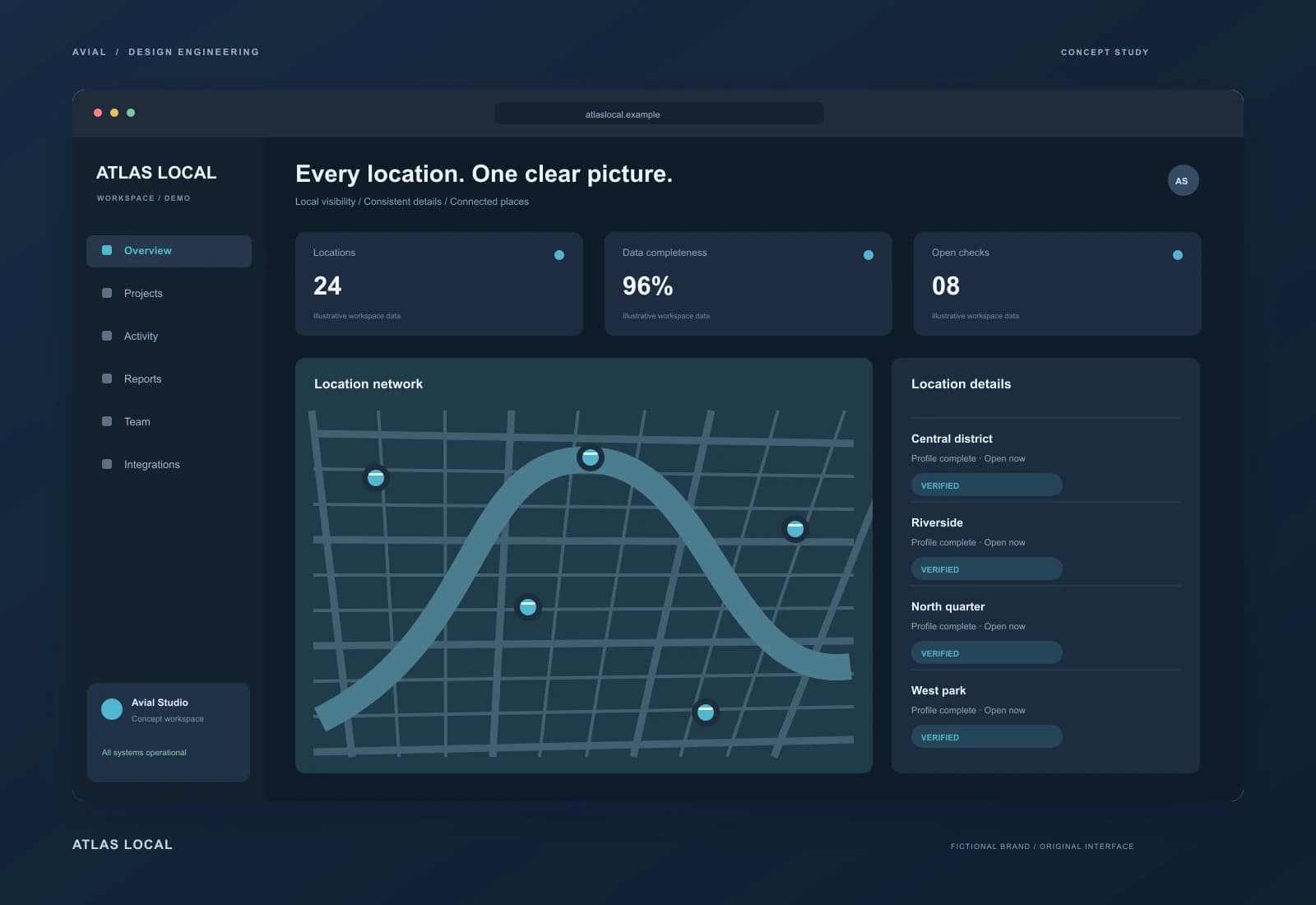
One search architecture, many locations
A local SEO concept for a multi-location business. Useful location pages combine services, contact details and directions, while a shared workspace highlights data gaps and inconsistencies.
Original concepts for fictional brands, illustrating our approach to design and implementation.
What you get
Review status codes, redirects, canonicals, robots, sitemaps and access to key pages.
Investigate images, fonts, scripts, layout shifts and interaction delays.
Document reproduction steps, proposed fixes and verification criteria for priority issues.
Choose representative pages and repeat checks after changes or releases.
A tool’s warning list is only a starting point. The useful question is which change addresses the cause, what else it may affect and how the team can detect a regression.
Review server responses, robots.txt, noindex, sitemaps, canonicals and internal links. Ecommerce reviews cover facets, pagination, duplicates and unavailable products. Technical eligibility does not guarantee indexing: the page's content and purpose also matter.
Compare the initial HTML with the rendered page, including content, links, metadata and resource failures. Check language URLs, canonicals and reciprocal hreflang annotations. Automatic language redirects should not prevent access to alternative versions.
Investigate slow main content, delayed interactions and layout movement. Before a migration, map URLs and redirects; after release, check pages and critical journeys. Prioritisation considers impact and how many users or page templates are affected.
Each finding includes a URL or template, reproduction conditions, evidence, expected behaviour and priority. Recommendations are distinguished from confirmed defects. Scoping requires the stack, available Search Console data and your important page types.
Development can be included or assigned to your team. Changes are checked in a test environment, with a rollback approach agreed before release. Indexing directives and URLs are not changed without an approved impact map.
Repeat checks after deployment and record issue status and remaining constraints. Test forms, menus, language switching and important business actions. Ongoing monitoring and regression response have an agreed period and scope.
Illustrative issues showing the format, not measurements from a client website. Actual values, URLs, device conditions and dates are recorded during the audit.
| Symptom | Investigation | Verification criterion |
|---|---|---|
| Main image appears late — LCP | Response time, resource discovery, size and priority | Repeat under the same lab conditions; review field data separately |
| Menu interaction is delayed — INP | Long tasks, event handlers and main-thread work | Retest the interaction and check for functional regressions |
| Content moves unexpectedly — CLS | Reserved media space, fonts and dynamic content | Reproduce loading and interactions; inspect layout shifts |
Scope depends on templates, technology, languages, analytics readiness and access to code and environments. The proposal separates audit, development, deployment and verification. It includes the URLs or page types being reviewed and the acceptance criteria.
To start, share your website, observed problem, CMS or stack and any planned migration. Search Console, analytics, repository or log access is agreed according to the task. Your data and access remain under your control; you receive the change log and verification results.
Good Core Web Vitals targets are LCP at or below 2.5 seconds, INP at or below 200 milliseconds and CLS at or below 0.1. Field assessment uses the 75th percentile, segmented by mobile and desktop. These are user-experience targets, not a promise of Google rankings.
Lab testing helps reproduce and verify a defect. Field data reflects real visitors; CrUX summaries use a rolling 28-day window, so a release is not reflected immediately. Where URL data is insufficient, we identify the aggregation level and do not present a Lighthouse score as proof of passing field CWV.
From brief to launch
Collect lab measurements and available field data.
Investigate representative pages and devices.
Coordinate changes and dependencies with engineers.
Repeat the journeys and leave a reusable check set.
Before we start
No. Scores depend on conditions, content and third-party services. The goal is measurable improvement in user journeys with understood trade-offs.
Lab tests use controlled conditions; field data reflects different visitors over time. We analyze both sources without treating them as interchangeable.
Yes. You receive prioritized tasks and verification criteria. Implementation and follow-up validation can be scoped separately.
We review server responses, directives, canonicals, duplicates, internal links and page content. Crawl accessibility is only one condition. The search engine's final indexing decision and timing cannot be guaranteed.
Yes. We review initial and rendered HTML, resource accessibility, links and metadata. Recommendations depend on the stack and observed issue; SSR alone does not resolve every SEO problem.
We reconcile language URLs, canonicals, reciprocal hreflang, page status and sitemaps. Links should reach the equivalent published translation and navigation should allow explicit language selection.
We disclose the limited sample, review available origin-level data and use lab measurements for diagnosis. Your own real-user monitoring can be scoped separately and is identified as a distinct data source.
Alongside performance, we check forms, menus, purchases or other agreed journeys. SEO changes also require URL status, metadata and directive checks. Acceptance criteria and the rollback approach are agreed before deployment.
The scope can include old-to-new URL mapping, redirects, metadata transfer, indexing checks and post-launch monitoring. A migration requires its own release plan and named responsibilities.
Functional fixes are checked after release. Field metrics need new visits and an updated data window. The proposal defines the monitoring period and response to newly observed issues.
AVIAL SERVICE
Share the address and describe the issue: loading, indexing or a particular interaction.
Tell us about your website and goal. We will clarify the scope, cost and next step. An inquiry does not commit you to a purchase.
Estimate IT service costs, book a consultation and try an enquiry automation example. Use the website check to start a discussion about technical SEO and page speed.